Electional astrology is a branch of astrology dealing with the selection of the most appropriate moment for taking an action to achieve the result that is the closest to the preferred one. For example, the moment of signing a lucrative contract requires a strong ruler of the first house as well as a strong, but a bit weaker, ruler of the seventh one. Such celestial configuration gives you a bit more advantage over your contractor, but without making them too weak, which could negatively influence your joint venture. But this is only one of many factors that should be considered to choose the best moment for such events.
Another, and I think less common, usage of elections is in magical practices. Rituals, amulets, charms, and others often need to be done at specific times of appropriate quality matching the principles of a ritual. Love spells, I think one of the most common, are related to Venus, so they should be performed during Venusian time. In this post, I will mainly focus on timing, as astrology offers insights into the quality of time.
Hairesis
Some planets feel and act better when they dwell in their sects – hairesis. There are two sects: diurnal and nocturnal. Almost each planet, except Mercury, belongs only to one sect.
Planets rejoicing in diurnal sect:
- Saturn
- Jupiter
- Sun
Planets rejoicing in nocturnal sect:
- Mars
- Venus
- Moon
Mercury, if raises before the Sun, is diurnal and nocturnal if raises after the Sun.
As one can see, the division is pretty logical. The Sun belongs to the diurnal sect, whereas the Moon to the nocturnal one. The planets belonging to the diurnal sect also belong to the Airy and Fiery triplicities while the nocturnal ones belong to Watery and Earth triplicities. So the diurnal planet feels better on the same side of the horizon with the Sun, and the nocturnal planet is “happier” on the side of the horizon that is opposite to the Sun.

Sun, Jupiter and Saturn in their diurnal sect.
Moon, Venus, Mars and Mercury in their nocturnal sect
In the example above, the Sun is below the horizon. This means Jupiter and Saturn, which are also below the horizon, are in their diurnal sect. Venus, Mars, and the Moon are on the opposite side, which means they are in their nocturnal sect. Mercury, since rising after the Sun, belongs to the nocturnal sect in which he dwells. Let’s take the chart above into consideration. If someone in Prague wants to embrace Venusian qualities by doing rituals on 6 September 2027, they need Venus to be in her sect. Venus in the chart is about to set in 16 minutes, so it may not be enough for such activities. Thus, it would be better to select another date. But this may be a perfect time for a ritual of attunement to the energies of Mars. Mars is in his nocturnal sect and in his domicile – Scorpio – and sets within 1.5 hours, which seems much easier to manage.
The sect is a basic accidental dignity, allowing one to choose the proper time for practising magic without spending much time checking this. However, this method of selecting the right moment works well for routine magical performances. It’s great for that kind of activities that aim to create internal changes in the soul through repeated rituals.
Planetary Days And Hours
In astrology, everything is linked with the seven or ten planets moving through the sky and the twelve zodiac signs. Throat is associated with Taurus, and brain is associated to Mercury. Saturn rules the right ear while Jupiter the left one and so on. It is no different with hours and days of the week. Every day has its ruler according to the following order.
| Day | Planet |
|---|---|
| Monday | Moon |
| Tuesday | Mars |
| Wednesday | Mercury |
| Thursday | Jupiter |
| Friday | Venus |
| Saturday | Saturn |
| Sunday | Sun |
The same applies to planetary hours. But the term “hour” is a bit different here. Planetary hour usually does not equal 60 minutes. It is because of the specific way of calculating them. Basically, day is divided into two parts: day and night, determined by the time of sunrise (beginning of the day) and by the time of sunset (beginning of the night). Each part contains 12 hours of equal length. Thus, a planetary hour lasts one hour only during the spring and autumn equinoxes. This is when the day and night are equal in length. In winter, planetary hours are shorter during the daytime than the nighttime, and opposite in summer. Here is how to calculate it.
To calculate planetary hours for a daytime:
- take the sunrise and sunset times
- calculate the daytime length
- divide the daytime length by 12
- the result is the length of one planetary hour during the daytime
To calculate planetary hours for a nighttime:
- take the sunset and sunrise times
- calculate the nighttime length
- divide the nighttime length by 12
- the result is the length of one planetary hour during the nighttime
Another fact is that the current planetary hour in Prague is likely the same as in Berlin (similar latitude), but it could be earlier than in Warsaw (much different latitude). It is because the planetary hours are calculated based on the local sunrise and sunset times, which makes calculations even more annoying.
Which hours belongs to which planet?
The rule here is that the first hour of the day belongs to the planetary ruler of the day. The next hour belongs to the next planet in Chaldean Order Of Planets1 and so on. Below table shows the complete order of the planetary hours within the daytime and the nighttime of the day.
| Hour | Monday | Tuesday | Wednesday | Thursday | Friday | Saturday | Sunday |
|---|---|---|---|---|---|---|---|
| 1 | Moon | Mars | Mercury | Jupiter | Venus | Saturn | Sun |
| 2 | Saturn | Sun | Moon | Mars | Mercury | Jupiter | Venus |
| 3 | Jupiter | Venus | Saturn | Sun | Moon | Mars | Mercury |
| 4 | Mars | Mercury | Jupiter | Venus | Saturn | Sun | Moon |
| 5 | Sun | Moon | Mars | Mercury | Jupiter | Venus | Saturn |
| 6 | Venus | Saturn | Sun | Moon | Mars | Mercury | Jupiter |
| 7 | Mercury | Jupiter | Venus | Saturn | Sun | Moon | Mars |
| 8 | Moon | Mars | Mercury | Jupiter | Venus | Saturn | Sun |
| 9 | Saturn | Sun | Moon | Mars | Mercury | Jupiter | Venus |
| 10 | Jupiter | Venus | Saturn | Sun | Moon | Mars | Mercury |
| 11 | Mars | Mercury | Jupiter | Venus | Saturn | Sun | Moon |
| 12 | Sun | Moon | Mars | Mercury | Jupiter | Venus | Saturn |
| Hours | Monday | Tuesday | Wednesday | Thursday | Friday | Saturday | Sunday |
|---|---|---|---|---|---|---|---|
| 1 | Venus | Saturn | Sun | Moon | Mars | Mercury | Jupiter |
| 2 | Mercury | Jupiter | Venus | Saturn | Sun | Moon | Mars |
| 3 | Moon | Mars | Mercury | Jupiter | Venus | Saturn | Sun |
| 4 | Saturn | Sun | Moon | Mars | Mercury | Jupiter | Venus |
| 5 | Jupiter | Venus | Saturn | Sun | Moon | Mars | Mercury |
| 6 | Mars | Mercury | Jupiter | Venus | Saturn | Sun | Moon |
| 7 | Sun | Moon | Mars | Mercury | Jupiter | Venus | Saturn |
| 8 | Venus | Saturn | Sun | Moon | Mars | Mercury | Jupiter |
| 9 | Mercury | Jupiter | Venus | Saturn | Sun | Moon | Mars |
| 10 | Moon | Mars | Mercury | Jupiter | Venus | Saturn | Sun |
| 11 | Saturn | Sun | Moon | Mars | Mercury | Jupiter | Venus |
| 12 | Jupiter | Venus | Saturn | Sun | Moon | Mars | Mercury |
There are apps and websites2 showing the current planetary days and hours for the selected location, making it easy to check without manual calculations as long as there is no power outage; but in such cases, this will be the least important thing to worry about. Many astrological applications have the option to view the planetary day and hour for the horoscope.
How does this relate to magic?
Most books describe rituals that include a section on when to perform them. If not, it means either it is not relevant or one has to decide what is the best time. Usually, one can find the planetary hour and day there. And this seems to be the most common approach I observed while reading forums and discussion groups. So, for example, rituals utilising Saturnian qualities should be performed on Saturday daytime in the planetary eighth hour or in the tenth planetary hour nighttime. Simple as that.
The Moon
The Moon is fundamental in all elections, no matter of what the purpose is. Obviously, the Moon should not be debilitated while performing magic rituals.
Combustion
The Moon is combust when she is in the same sign with the Sun and not distant from the Sun eight degrees and thirty minutes, either before or after the Sun. The Moon is said to be under the Sun beams when she is within 15 degrees before or after the Sun. During that period, nothing new will come.
Fall or Detriment
The Moon being in her fall or detriment – Scorpio or Capricorn – does not foster casting spells. The same applies when she is moving through the Via Combusta from the 15th degree of Libra until the 15th degree of Scorpio.
The sign and the house
It is good if the Moon is in the sign related to the subject of the ritual one wants to perform. And it would be even better if she is in the angular or at least in the succedent house. But, the lord of the ascendant should be well-placed too – in its domicile or exaltation, for example Sagittarius is rising and Jupiter is in Cancer.
Wanning or waxing phase
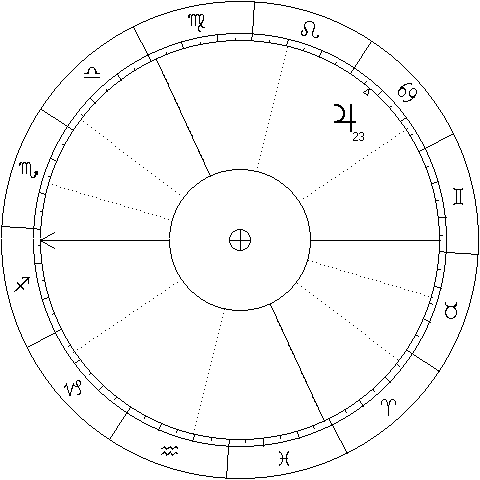
The Moon during half of her cycle is wanning. If one wants to attract some values or make them increased, this is not the best period for rituals aiming to this. It is better to wait for the waxing phase.
Void of course
The Moon is in void of course when she is not going to make an aspect before leaving the current sign. It ends when she enters the next sign. Usually, void of course happens when the Moon is in the last degrees of the current sign. If one wants to perform rituals aiming to keep the things or trends unchanged, this may be supportive period for such activities but should be carefully considered.

The Moon in void of course for around 40 minutes
In the above example, the void of course of the Moon lasts only around 40 minutes. She separates from Mercury, and she will not make a new aspect before leaving Capricorn.
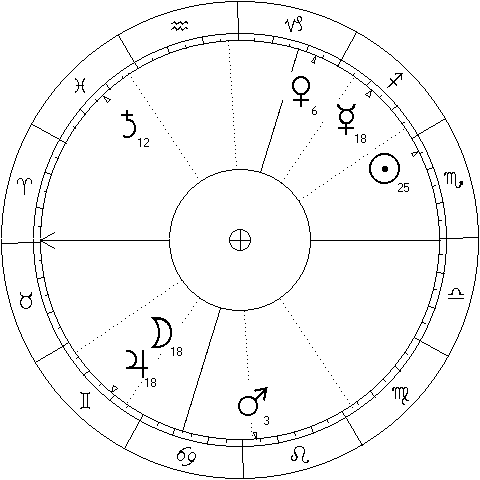
The Moon in void of course for around 19 hours
The next example shows the Moon in her void of course for around 19 hours. She is separating from Jupiter and will not make an aspect until leaving Gemini. So the length of the period may differ significantly, sometimes it may be even unnoticeable.
Aspects
In general, the Moon should not make an aspect to a debilitated planet, such as the planet in fall or the cadent house. She should also be applying to benefics or, if the ritual is related to qualities of these planets, to malefics.
Let’s elevate it a bit
Usually, the ritual is related to some principle: planetary, elemental or zodiacal one. The main focus while working on elections for the ritual is therefore to strengthen the element being the desired principle. So, if one wants to cast a love spell, it means the Venus – a planet of love – should be as strong as possible in the horoscope for the moment of the ritual. Firstly, the time of the ritual should be on the day of Venus and preferably at her hour. She should be in the angular house, in the sign of her dignity – Taurus, Libra, or Pisces. It would be even better if she is making an aspect to Jupiter or at least she is afflicted by Saturn and Mars. The Moon should be in her waxing phase.
This appears to be very complex to meet all these requirements, so the main focus should be on those that can be achieved in a reasonable timeframe.
Perfect Elections
Does not exist. The only perfect horoscope is Thema Mundi3 and no other. Get used to it. Period.
Conclusions
There are plenty of factors supporting magical activities, and it is obvious that they cannot all be combined to obtain a perfect election which makes the perfect moment. It should be rather balanced to select the most optimal moment. In fact, these are very theoretical considerations because from what I noticed is that the most common is to select a proper day and hour and that is all. In general, the “rule” here is that the more critical is the ritual, the more care should be put into selecting the right moment. But on the other hand, it is not possible to select the ideal election, so avoid waiting forever for the perfect moment and do nothing. So remember, the perfect election does not exist.
Posted by

Comments:
- Saturn, Jupiter, Mars, Sun, Venus, Mercury, Moon ↩︎
- for example on planetaryhours.net ↩︎
- wikipedia.org ↩︎
Featured image: Saul en de heks van Endor, William Sharp, 1788, Rijksmuseum, Public Domain.
Charts generated with Urania PRO.